

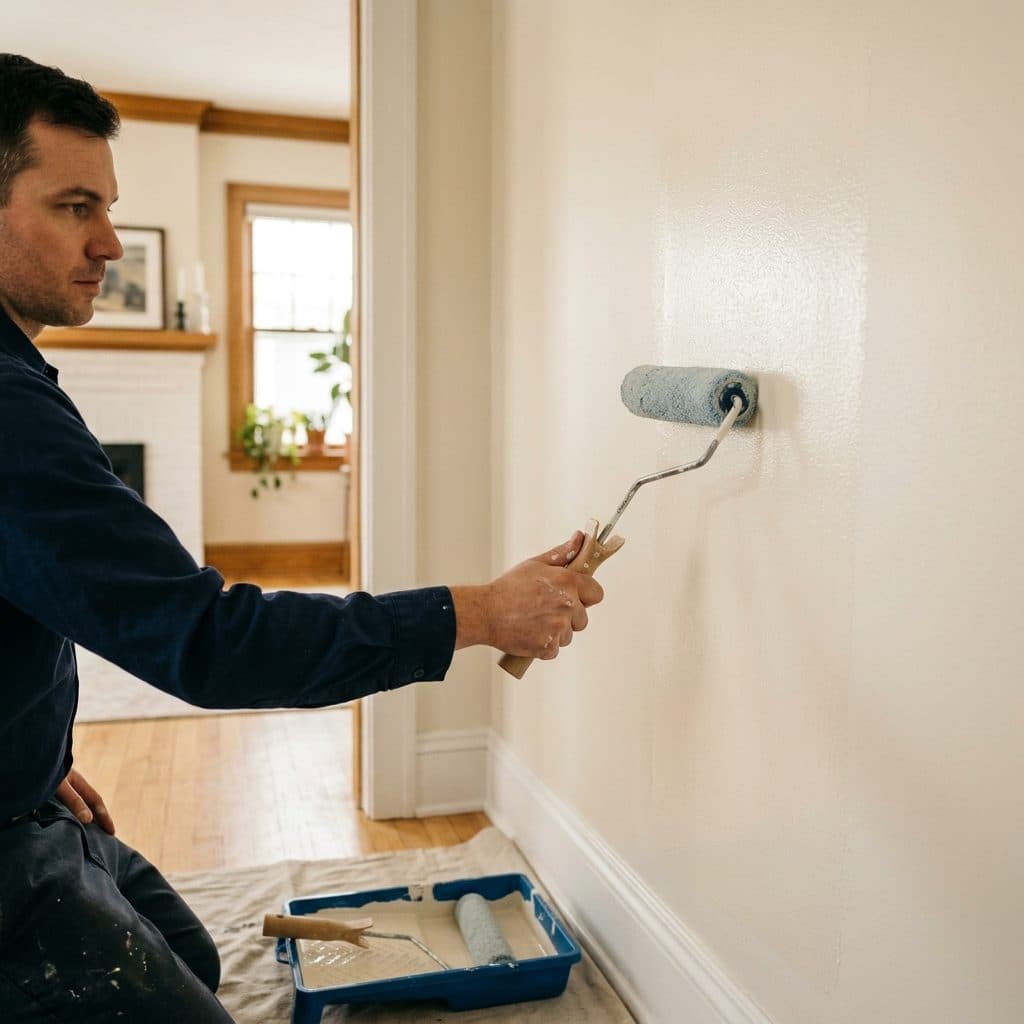
Wondering how long between coats of latex paint you should wait? The short answer is 2 to 4 hours under normal conditions.
But normal conditions do not always show up in a Minnesota home. Temperature, humidity, and the season all play a part. Here is what actually affects that wait time, and how to get it right.
Key Takeaways
Dry, Ready to Recoat, and Fully Cured Are Not the Same Thing
These three stages sound alike, but they are not.
Dry to the touch means the surface feels dry, but the paint underneath may still be soft. Ready to recoat means enough time has passed that a new coat will bond well. Fully cured means the paint has reached its full hardness and durability.
Here is how the stages typically break down for latex paint compared to oil-based paint and primer.
| Paint Type | Dry to Touch | Ready to Recoat | Fully Cured |
|---|---|---|---|
| Latex | 30-60 minutes | 2-4 hours | 2-3 weeks |
| Oil-based | 6-8 hours | 24 hours | 5-15 days |
| Latex primer | 30-60 minutes | 1 hour | Varies by product |
Durahome applies two finish coats of Sherwin-Williams premium product on every project. Sherwin-Williams lists similar dry and cure times for their latex lines, so these numbers hold up well as a general guide.
What Affects How Long Latex Paint Takes to Dry Between Coats
A few factors decide whether your wall is ready in 2 hours or closer to 6.
Temperature
Cold walls dry slower, even if the room feels warm. An exterior wall in winter can run several degrees cooler than the thermostat shows. That cooler surface needs more time before the next coat goes on.
Humidity and Season
Humid air slows drying because there is less room for moisture to evaporate. Dry winter air can do the opposite: it can make paint feel dry on the outside while it is still wet underneath. Both situations call for extra patience.
Coat Thickness
Thin coats dry faster than thick ones. Two thin coats almost always beat one heavy coat, both for drying time and for the final look.
Paint Sheen
Shiny finishes like semigloss and gloss can seal faster on the surface. That can trap moisture underneath, so these sheens may need a bit more time than flat or eggshell paint.
Recoat Times Adjusted for Minnesota Homes
The label on your paint can gives you a starting point. Minnesota weather often asks for a little more patience.
| Surface | Standard Recoat Time | Minnesota-Adjusted Time |
|---|---|---|
| Interior walls and ceilings | 2-4 hours | 4-6 hours in winter |
| Trim, doors, and cabinets | 2-4 hours | 4-6 hours, longer for dark colors |
| Exterior siding | 2-4 hours | Depends on sun, wind, and dew point |
Exterior recoat timing depends on more than the clock. Sun exposure, wind, and the daily dew point all affect it, which is part of why the best time to paint an exterior in Minnesota matters as much as the wait between coats.
How to Tell if Your Paint Is Ready for the Next Coat
You do not need any tools for this. Three quick checks will tell you what you need to know.
- Touch test: Press lightly. The surface should feel dry and firm, not sticky.
- Glide test: Run your fingers across it. They should move smoothly with no drag.
- Look test: Check for shine. An even, matte look means it is ready. Shiny or dark patches mean it is not.
What Happens When You Recoat Too Soon
Rushing the second coat causes real problems, not just cosmetic ones.
The new coat can pull up the one underneath, leaving rough patches. Roller marks that would have disappeared can get locked in permanently. The finish can turn cloudy or uneven in certain light. Down the road, that surface may not clean as well as it should, which sometimes shows up as foggy or hazy paint months later.
What Happens When You Wait Too Long Between Coats
Waiting too long causes its own issue. After about 30 days, latex paint can cure to a surface that is too smooth for the next coat to grip well.
If it has been more than a few days, just wipe away any dust before you recoat. If it has been over a month, a light pass with fine sandpaper first will help the new coat bond the way it should.
Tips to Help Paint Dry Faster Without Ruining the Finish
A few simple habits speed up drying without hurting the finish.
Keep air moving with a fan or an open window, rather than pointing direct heat at the wall. The EPA recommends increasing ventilation any time you are working with paint, which also helps it dry evenly. Keep the room between 60 and 80 degrees if you can. Apply thin, even coats instead of one thick one.
For choosing colors by room, lighter shades and flatter finishes tend to dry a bit faster than dark, glossy ones, which is worth factoring into your timeline.
Why Recoat Timing Is One Reason Homeowners Hire a Professional Painter
Managing recoat time across an entire home is harder than it sounds. Different rooms hold different temperatures. Exterior walls dry differently than interior ones. A single "wait 4 hours" rule rarely fits every surface in the same house.
This is one of many small decisions that add up to a paint job that holds up for years instead of months. It is also part of why professional painting outperforms DIY on bigger projects: someone is tracking every surface, not just the one you are standing in front of.
Durahome's crew manages that timing wall by wall, project by project. A few reasons homeowners trust that process:
One Group Text - production manager, owner, estimator, and crew foreman in one thread from day one
The Same Crew - around 90% painter retention, most with close to a decade of experience
Sherwin-Williams - premium products throughout every project
2-5 Year Written Warranty - scaled to the scope of the job
If you are weighing a full repaint, our interior painting cost guide breaks down what drives the price for Twin Cities homes.
The Short Minnesota Painting Season Rewards Patience Between Coats
Waiting the right amount of time between coats is one of the easiest ways to protect a paint job. Rushing it costs more in the long run, whether that shows up as peeling, streaks, or a finish that fails early.
Whether you are painting one room yourself or planning a full home repaint, Durahome is here to help. Request your free estimate or call (612) 800-0273 to talk through your project.
Frequently Asked Questions
Can you apply a second coat of latex paint after one hour?
In most cases, no. Latex paint usually needs 2 to 4 hours before it is ready for a second coat, even though it may feel dry to the touch after 30 to 60 minutes.
Does latex paint dry faster in hot or cold weather?
Warm, moderate conditions between 60 and 80 degrees dry paint fastest. Cold temperatures slow drying, and very hot, humid days can slow it too.
How long does latex paint take to fully cure?
Full cure usually takes 2 to 3 weeks. The paint is safe to recoat well before that, but it is still building hardness during this window.
Is recoat time different for ceilings than for walls?
Not usually, as long as the room temperature and humidity are the same. Ceilings can take slightly longer if they sit closer to warm, rising air.
Do you need to sand between coats of latex paint?
No, not if you are recoating within the normal window with the same paint and sheen. Light sanding only helps if you waited longer than about 30 days.