

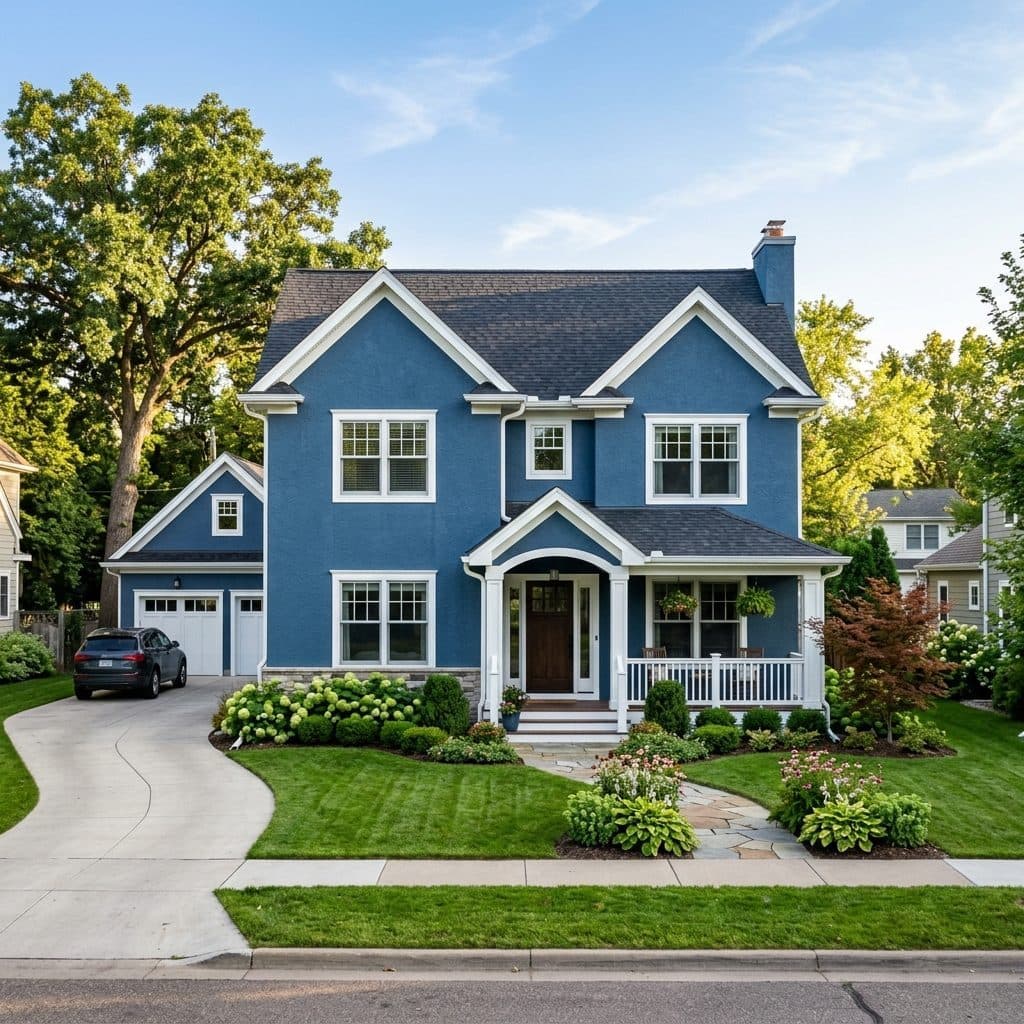

A blue stucco house stands out without trying too hard. While neutrals dominate most Twin Cities neighborhoods, blue is gaining ground with homeowners who want curb appeal that feels fresh, confident, and a little different from every beige exterior on the block. The key is choosing the right shade, pairing it with the right trim and roof, and making sure the stucco surface underneath is ready to hold a finish through Minnesota's freeze-thaw seasons.
This guide covers the stucco house colors that actually work in blue, which Sherwin-Williams shades to consider, how to pair trim and roof for a cohesive look, and what a professional exterior stucco painting project involves in a cold climate.
Key Takeaways
Why Blue Works on a Blue Stucco Exterior?
Stucco has a dimensional, textured surface that responds to light differently than wood lap siding, vinyl, or smooth-finish materials. When a blue stucco exterior catches morning sun on one wall and afternoon shade on another, the color shifts through the day, giving the home a depth that flat surfaces cannot match. That interplay between texture and light is one reason blue looks richer on stucco than on most other substrates.
Blue is also uncommon enough in the Twin Cities that it creates immediate curb appeal without veering into anything extreme. In established neighborhoods with a mix of beige, white, and gray exteriors, a well-chosen blue reads as intentional. In newer suburbs where homes share similar footprints, it creates separation. The shade and how it pairs with trim, the roof, and the front door determines whether the result feels subtle, bold, or somewhere between.
The practical question most homeowners land on is not whether blue looks good on stucco, but which blue, which trim, and whether the surface is ready. Those are the decisions that separate a finish that holds up from one that fades, cracks, or peels within a few seasons.
Shades of Blue That Work as Exterior Stucco Paint Colors
Not every blue reads the same on stucco. The texture amplifies some tones and mutes others, and the surrounding light, roof color, and landscaping shift the mood. Here are four shade categories that work well, with Sherwin-Williams options for each.
Light Blue and Soft Blue-Gray
Light blues create a calm, welcoming feel. On stucco, they pick up warmth from the texture and avoid the flat, washed-out look they can have on smooth siding. These shades suit ramblers, cottages, and Cape Cod-style homes. They pair naturally with bright white trim and look clean against dark or medium gray roofs.
Sherwin-Williams options: Windy Blue (SW 6240) is a soft, airy blue with just enough gray to keep it grounded. Languid Blue (SW 6226) sits slightly deeper, with a calming presence that reads as a true medium-light blue in full sun and settles into a muted tone in shade.
Navy and Dark Blue
Navy on stucco is dramatic without being aggressive. The texture softens what could feel heavy on a smooth surface, and the result is a finish that reads as sophisticated and grounded. Navy works well on two-story homes, modern designs, and traditional exteriors with strong architectural lines.
Sherwin-Williams options: Naval (SW 6244) is a true, rich navy with warm undertones that prevent it from reading cold. Salty Dog (SW 9177) is deeper and slightly cooler, with a near-black quality in shade that creates high contrast with white or cream trim.
Teal and Blue-Green
Teal brings energy and a sense of modernity. On stucco, teal and blue-green shades create a vibrant, textured look that works for contemporary homes and Mediterranean-inspired designs. These colors pair well with warm-toned trim (cream, natural wood) and terracotta or brown roofing.
Sherwin-Williams options: Riverway (SW 6222) is a deep, moody teal that shifts between blue and green depending on the light. Still Water (SW 6223) carries similar depth with a slightly bluer lean, suiting homes where the goal is blue-dominant with a green undertone rather than the reverse.
Dusty Blue and Muted Blue
Dusty blues function almost as neutrals. They carry enough color to separate the home from the beige-and-gray standard, but they stay subtle enough to avoid the boldness of navy or teal. These shades are forgiving in mixed-style neighborhoods and age gracefully because fading is less visible on muted tones.
Sherwin-Williams options: Blustery Sky (SW 9140) is a rich blue-gray that appears vibrant in direct sun and settles into a charcoal-adjacent tone in shade. Uncertain Gray (SW 6234) leans blue with enough gray to read as a cool neutral, a strong choice for homeowners who want blue to be felt rather than announced.
Trim, Door, and Roof Pairings for a Blue Stucco House
The blue shade is only half the decision. Trim, front door, and roof color determine whether the finished exterior feels classic, modern, warm, or bold. Here are the pairings that work.
| Blue Shade | Trim Color | Front Door | Roof Color | Overall Feel |
|---|---|---|---|---|
| Light blue | Bright white | Yellow, coral, or black | Medium gray or charcoal | Airy, coastal, cheerful |
| Navy | Crisp white or cream | Red, brass, or white | Black or dark charcoal | Classic, dramatic, grounded |
| Teal | Natural wood or cream | Warm wood or orange | Brown, terracotta, or dark gray | Mediterranean, vibrant, warm |
| Dusty blue | Charcoal or dark gray | Deep green or matte black | Dark gray or slate | Modern, understated, sophisticated |
| Any blue | Matching blue (lighter or darker) | Contrasting accent | Neutral (gray, brown, or black) | Monochromatic, cohesive, sleek |
A few pairing principles worth keeping in mind. White trim creates the sharpest contrast and makes the blue pop. Natural wood trim softens the look and adds warmth, which balances darker blues. Black accents (window frames, hardware, lighting) push the design toward modern. Cream or beige trim creates a traditional, approachable feel without the sharpness of white.
Roof color matters more than most homeowners expect. A dark roof with navy stucco creates a bold, anchored facade. A lighter roof with soft blue stucco keeps the entire exterior feeling airy. If the home already has a fade-resistant exterior paint on the trim, the trim shade becomes the anchor point for choosing the body color.
Painting Stucco in Minnesota: What the Climate Demands?
Color inspiration is the starting point, but in Minnesota, what happens before the paint goes on matters more than the shade on the swatch. The Twin Cities climate puts specific demands on stucco coatings that warmer, drier regions do not face.
- Freeze-thaw cycling is the primary concern. Water enters hairline cracks, freezes, expands, and widens those cracks over time. If the stucco surface carries unrepaired cracks when new paint is applied, the coating bridges the gap temporarily but fails as the crack moves through another winter cycle. Every crack needs to be filled and primed before the finish coat goes on.
- Moisture and breathabilitydetermine which paint type belongs on the wall. Acrylic latex exterior paint (such as the Sherwin-Williams Loxon line, designed specifically for masonry and stucco) lets moisture pass through the coating rather than trapping it behind the film. Elastomeric paint is thicker and bridges hairline cracks, but it seals the surface. On stucco that is damp, failing, or not fully cured, elastomeric coatings can trap moisture behind the film, causing blistering and peeling. The right call depends on the stucco's current condition, and an on-site evaluation is the only way to know for certain.
- UV exposure is highest on south and west-facing walls. Blue pigments are more sensitive to UV breakdown than earth tones and neutrals. Deeper blues (navy, dark teal) show fading more visibly than lighter or muted shades. A quality fade-resistant exterior acrylic, applied in two coats over properly primed substrate, is the standard defense. Industry-wide, exterior paint on stucco typically lasts 5 to 10 years before recoating is needed, and that range holds tighter with proper prep and product selection.
- Flat or matte sheenis the standard recommendation for stucco exteriors. Flat finishes hide the surface's natural imperfections and create a clean, uniform read. Satin can work on smooth-finish stucco, but on textured surfaces, it can highlight unevenness.
For a full picture of how Minnesota weather damages exterior surfaces and what to watch for on stucco specifically, Durahome's guide to signs of stucco problems covers cracks, efflorescence, and surface failures that should be addressed before any paint project begins.
What a Blue Stucco Exterior Painting Project Looks Like
Choosing the color is the visible decision, but the project behind it is where the finish earns its lifespan. Here is what a typical exterior stucco painting project looks like with Durahome.
- Estimate visit. An estimator evaluates the stucco in person: surface condition, existing coatings, cracks, growth, moisture signs, access requirements, and how many stories need staging versus ladder work. Durahome estimates on the high side over the phone and often comes in lower once the home is seen in person. The written estimate is exact, always free, and breaks out scope by area rather than burying everything in a single total.
- Surface preparation. This is roughly 80 percent of the labor on a residential exterior. The stucco is washed and treated (growth killed, not just blasted off), cracks are filled and primed, failing edges are scraped and feathered back to sound coating, and open joints are caulked and sealed. In a freeze-thaw climate, sealing open joints is core scope, not an add-on.
- Two finish coats. Two coats of Sherwin-Williams exterior product go on over the prepped surface. The sheen is matched to the texture (flat for most stucco). Color is confirmed with the homeowner before application, and Durahome always recommends testing a sample on the actual wall before committing, because stucco reads color differently than a paint chip.
- Final estimate. The project is not done until the homeowner and Durahome walk the exterior together.
Most Twin Cities exterior repaints, including stucco, run $6,000 to $8,000 for a standard home. Size, stories, stucco condition, and prep scope move the number. For a detailed breakdown, Durahome's exterior painting cost guide covers what drives price and what is always included.
One Group Text: production manager, owner, estimator, and crew foreman in one thread from day one
~90% Crew Retention: most painters carry close to a decade of experience
Sherwin-Williams products throughout
2-5 year written warranty, scaled to the scope of the project
Blue Stucco, Done Right
Choosing blue for a stucco exterior is a decision homeowners tend to feel good about for years, as long as the shade fits the home, the pairings are intentional, and the surface underneath is ready to hold a finish through real weather. In Minnesota, that last part is not optional.
Durahome Painting Plus handles exterior stucco projects across the Twin Cities metro: Minneapolis, St. Paul, and suburbs including Edina, Golden Valley, St. Louis Park, Minnetonka, Maple Grove, Eden Prairie, and Woodbury. The estimate identifies the stucco's condition before anything is quoted, and the project is managed from the first group text to the final estimate.
Ready to see what blue could look like on your home? Request a free estimate or call (612) 800-0273.
Frequently Asked Questions
Can you paint stucco any color, including blue?
Stucco accepts virtually any exterior paint color, including the full range of blues. The surface needs to be clean, dry, free of failing coatings, and primed with a masonry-appropriate primer before the finish color is applied. A 100 percent acrylic latex exterior paint is the standard product type for painted stucco.
What is the best paint finish for stucco exteriors?
Flat or matte finishes are recommended for most stucco because they hide the surface's natural texture variations and minor imperfections. Satin can work on smooth-troweled stucco, but on a standard textured finish, flat provides a cleaner, more uniform appearance.
How long does exterior paint last on stucco in Minnesota?
With proper surface preparation and a quality acrylic exterior paint, a stucco paint job in Minnesota typically lasts 5 to 10 years before recoating is needed. Freeze-thaw cycling, UV exposure (especially on south and west walls), and the condition of the stucco at the time of painting all influence the timeline.
Should I use elastomeric paint on my stucco house?
It depends on the stucco's condition. Elastomeric coatings bridge hairline cracks and provide strong waterproofing, but they seal the surface. On stucco that holds moisture or has underlying damage, elastomeric paint can trap water behind the film and cause blistering. An on-site evaluation determines whether standard acrylic or elastomeric is the right product for the wall.