

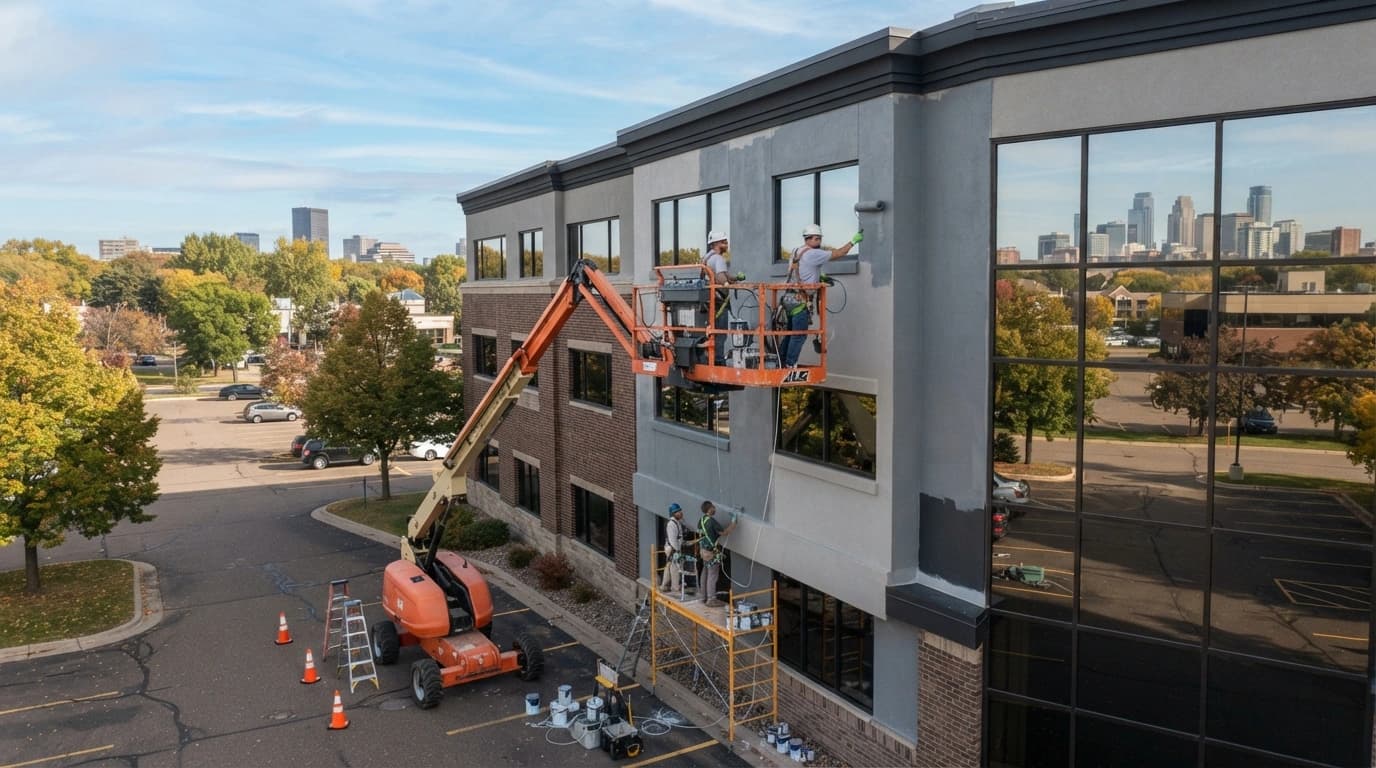
Getting a straight answer on commercial exterior painting cost is harder than it should be. You call three contractors, get three numbers that are thousands apart, and none of them explain what is actually in the price. The building needs paint, the budget needs a number, and what you are finding online is a range wide enough to be useless. This page breaks down what commercial building owners across the Twin Cities metro are actually paying, what moves the price in Minneapolis, St. Paul, and the surrounding suburbs, and how to get a number you can plan around.
Key Takeaways
What Twin Cities Commercial Building Owners Are Paying Right Now?
Most online cost guides put commercial painting somewhere between $2 and $6 per square foot. That range covers everything from a warehouse interior to a detailed retail storefront exterior, which is why it does not tell you much on its own.
Exterior-only commercial work across the Minneapolis and St. Paul metro, from downtown office buildings to suburban industrial parks in Plymouth and Burnsville, typically runs $3–$6 per square foot of paintable surface. The range narrows once you know the building type, surface condition, and how much access equipment the crew needs. Here’s how much it costs to paint commercial exteriors at different scales:
| Building Size (Paintable Sq Ft) | Typical Exterior Cost Range |
|---|---|
| 2,500 sq ft | $7,500–$15,000 |
| 5,000 sq ft | $15,000–$30,000 |
| 10,000 sq ft | $25,000–$50,000 |
| 20,000+ sq ft | $50,000–$120,000 |
These estimates reflect typical exterior commercial painting costs, with the lower end assuming sound surfaces and minimal preparation. The higher end accounts for multi-story access, substrate repairs, and specialty coatings. Actual pricing depends on the building’s condition, paintable surface area, and project requirements.
One thing worth knowing: paintable surface area is not the same as building footprint. A 5,000-square-foot warehouse with 20-foot walls has a far more paintable surface than a 5,000-square-foot retail strip with 12-foot walls, even though the footprint is the same. Any estimate built only on floor area will miss this.
Per-square-foot ranges are useful for budgeting, but they are a starting point. They cannot account for surface condition, access challenges, or the specific coating system your building needs. These factors can cause significant price differences between buildings of the same size, with commercial painting costs per square foot also varying depending on whether the project involves interior or exterior surfaces. An on-site walkthrough helps identify these variables and provides a more accurate estimate.
What Drives the Price of an Exterior Commercial Paint Job
How Building Size and Height Change the Math
Square footage sets the baseline, but height is where the cost curve bends. A single-story warehouse with 10,000 square feet of wall space is a different project than a three-story office building with the same total surface area.
Above two to three stories, the crew needs scaffolding, boom lifts, or swing stages instead of extension ladders. Equipment rental runs $500–$1,500 per day depending on the lift type and reach, and multi-story buildings typically need that equipment on site for the full duration of the project. A four-story office building in downtown Minneapolis will carry a higher per-square-foot cost than a ground-level retail strip in St. Louis Park, even if the total paintable area is similar, because the access equipment, rigging time, and downtown staging logistics add up.
Why the Surface Material Matters More Than You Think
Not every exterior substrate takes paint the same way, and the prep each one needs is where most of the cost variation hides.
Stucco and EIFS are common on Twin Cities commercial buildings, especially the office parks and retail centers built across Eden Prairie, Minnetonka, and Woodbury in the 1990s and 2000s. Hairline cracking is normal in a freeze-thaw climate, and those cracks need filling and priming before any coating goes on. Elastomeric coatings work well here because they flex with the substrate, but they cost more per gallon than standard acrylic.
Brick and masonry can be straightforward if the mortar joints are sound. Older brick commercial buildings along University Avenue, in St. Paul's Lowertown, and throughout Northeast Minneapolis often show efflorescence (the white mineral deposits that leach through), which needs chemical cleaning and neutralizing, or the new coating blisters within a season. Power washing alone does not solve it.
Metal panel and steel siding are typical on warehouses and industrial buildings in areas like the North Loop, Fridley, and Brooklyn Park. Rust treatment and a primer formulated for metal are required. Spot rust left under new paint spreads fast, especially on south and west-facing walls that take the most UV and temperature swing.
Wood siding and trim on older commercial buildings in Minneapolis neighborhoods like Whittier and Uptown, and along St. Paul's Grand Avenue and Summit Hill, often carry multiple paint layers with adhesion failures underneath. Scraping back to sound coating and spot-priming bare wood is most of the labor on these buildings.
Buildings with fading or chalking paint often need more than a fresh coat, as commercial exterior paint can lose its finish due to UV exposure, moisture, and weather-related wear.
Coatings and Paint Systems for Commercial Exteriors
The coating system is not just "what color." It is the product spec that determines how long the finish lasts, how it handles moisture and UV, and how much it costs per gallon.
| Coating Type | Cost Per Gallon | Best For |
|---|---|---|
| Standard acrylic latex | $25–$60 | General exteriors, wood, stucco |
| Elastomeric | $40–$80 | Stucco, EIFS, masonry with hairline cracking |
| Epoxy/urethane | $50–$120 | Industrial, metal, high-traffic surfaces |
| Specialty (anti-graffiti, fire-resistant) | $75–$150 | Retail, public-facing, code-required |
Most commercial exteriors in the Twin Cities get a two-coat system: a primer matched to the substrate, plus two finish coats. Going with a single coat to save money shortens the repaint cycle and usually costs more over five years than doing it right once.
Prep Work and Repairs That Add to the Estimate
Surface preparation is most of the labor on a commercial exterior, and it is the line item that separates a two-year paint job from a seven-year one.
Typical prep includes power washing (sometimes with chemical treatment for mildew or efflorescence), scraping and sanding failing edges, caulking open joints, patching damaged areas, and priming bare substrate. On a building with deferred maintenance, prep can account for 60 to 80 percent of the total labor hours.
For buildings constructed before 1978, lead paint testing is a regulatory requirement before any scraping or sanding begins. Lead abatement, if needed, adds cost and timeline. The EPA's Renovation, Repair, and Painting (RRP) rule applies to commercial projects where lead is present, and the Minnesota Department of Health enforces state-level lead standards on top of the federal requirements.
If your building is older, here is what Minnesota property owners need to know about testing for lead in paint.
Labor, Scheduling, and the Minnesota Calendar
Commercial painting labor in the Twin Cities runs $50–$100 per hour depending on crew size, project complexity, and whether the work happens during business hours. Rates in the metro have held steady through 2026, though crew availability tightens during the peak summer months when residential and commercial schedules compete.
Buildings that stay occupied during the project often require after-hours or weekend work to avoid disrupting tenants, customers, or operations. A medical office in Bloomington or a retail strip in Roseville with daytime foot traffic may need the crew on site evenings or weekends. After-hours rates typically run 20 to 30 percent higher than standard daytime labor. Phased scheduling (painting one section or face of the building at a time) adds coordination but keeps the business running.
Exterior painting in Minnesota has a real season. Consistent application weather runs from roughly May through October, though the best conditions for coating adhesion and cure fall between late May and mid-September. Temperature needs to stay above 50°F during application and for several hours afterward, and humidity and dew point matter just as much. Scheduling a commercial exterior project for late October is a gamble on Twin Cities weather that can delay the job or compromise the finish.
For a closer look at temperature and humidity windows, see the full guide on the best time to paint an exterior in Minnesota.
What Your Building Type Will Likely Cost
Office Buildings
Painting a two- to four-story office building in Edina, Golden Valley, or Bloomington typically costs $15,000–$40,000. Building height, exterior material, window masking, and site access affect the final price.
Warehouses and Industrial Facilities
Warehouses with metal siding or concrete block often cost less per square foot to paint because they have fewer architectural details. A 20,000-square-foot warehouse in Maple Grove or Fridley may cost $40,000–$80,000, depending on surface condition and access.
Retail Storefronts
Retail painting requires careful masking around signage and detailed finishes. A single storefront may cost $3,000–$8,000, while a strip of four to six units may cost $15,000–$30,000. After-hours scheduling can also affect pricing.
Multi-Unit Residential and Mixed-Use
Apartment buildings, condos, and mixed-use properties require coordination around residents, balconies, and shared walkways. Painting a 20-unit building may cost $30,000–$60,000, depending on siding, access, and project scope. Durahome handles commercial painting projects across the Twin Cities.
How Minnesota Weather Changes the Equation
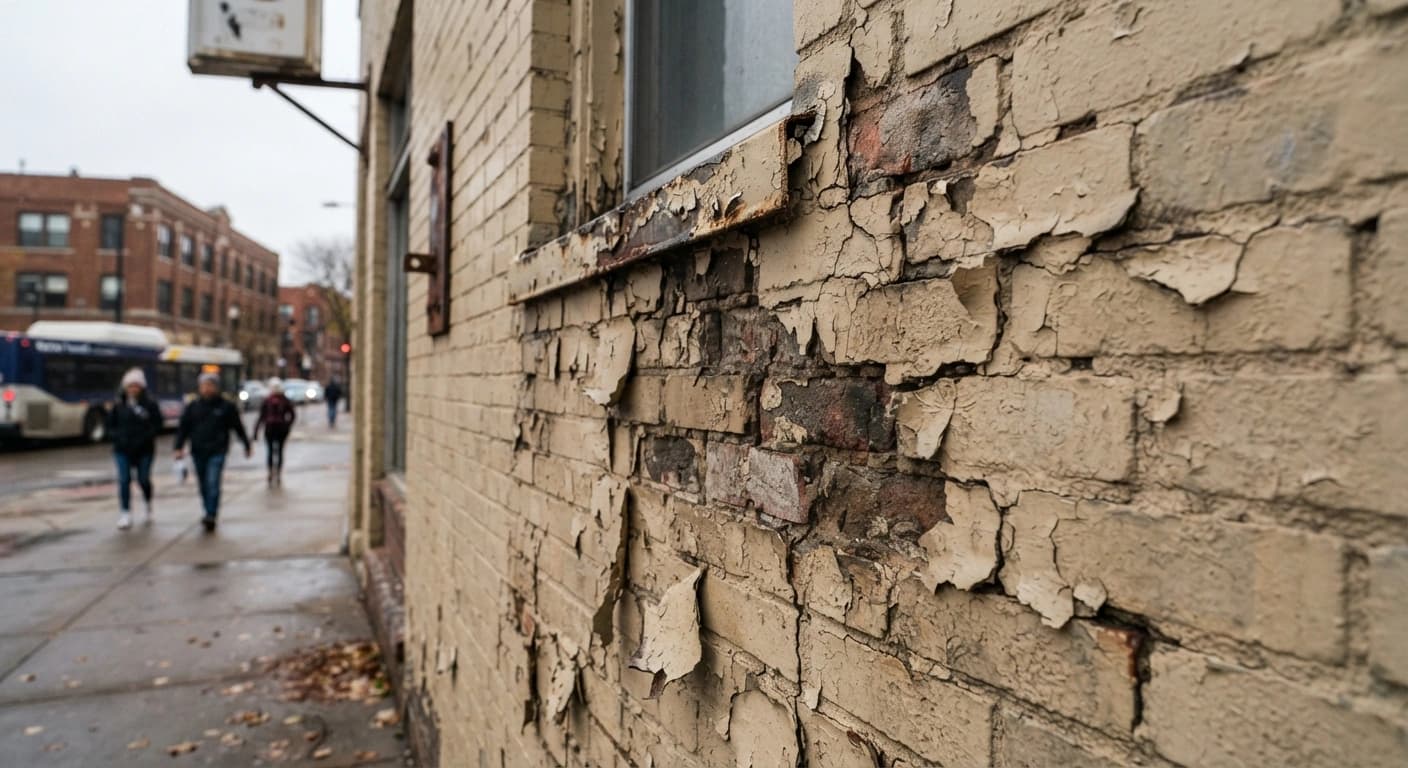
Commercial exteriors typically need repainting every seven to 10 years, but Twin Cities buildings may need fresh paint every five to seven years due to harsh weather.
The Minneapolis–St. Paul climate brings repeated freeze-thaw cycles, wind-driven rain, and temperature swings that allow moisture to enter small cracks and damage coatings. South- and west-facing walls also receive stronger UV exposure, which breaks down paint binders and causes chalking, fading, and peeling.
Summer humidity and morning dew can further affect paint application and curing, particularly near lakes and river corridors.
For budgeting, plan for inspections each spring to catch early signs of paint failure. Addressing cracks, chalking, and peeling promptly can help prevent more extensive surface repairs and keep future repainting costs manageable.
Twin Cities commercial buildings face repeated freeze-thaw cycles, UV exposure, and moisture that can shorten paint life. Understanding how Minnesota weather damages exterior surfaces helps explain why coatings crack, chalk, and peel over time. Choosing exterior paint that holds up through Minnesota winters can also help protect commercial surfaces against harsh seasonal conditions.
How to Get an Estimate You Can Actually Plan Around
Per-square-foot calculators are fine for ballpark budgeting, but they miss the variables that make one building $20,000 and the building across the parking lot $45,000. Surface condition, access, substrate type, coating spec, scheduling constraints, and building-specific repairs do not fit into a formula.
An on-site walkthrough is the only way to get a number that holds. Here is what that assessment should cover:
Durahome walks every commercial project before quoting. The written estimate breaks out prep, coating, access, and repairs as their own lines so you can see exactly what is in the price and what is driving it. No line items buried in a lump sum, no surprises after the crew starts.
One more thing: Durahome estimates on the high side over the phone and often comes in lower once the walkthrough is done. The written estimate is exact and always free. Call (612) 800-0273 or request an estimate through the site.
Why Twin Cities Property Owners Work with Durahome
Durahome Painting Plus has painted commercial and residential properties across Minneapolis, St. Paul, and the surrounding suburbs since 2016. The company is built around four things commercial building owners care about:
Durahome holds a 4.8 Google rating from 140 Twin Cities reviews and is a PCA (Painting Contractors Association) member. Fully licensed and insured.
Your Building Deserves More Than a Guess
You have the ranges, the cost drivers, and the variables. The next step is getting a number built on your building, not a formula. Durahome walks every commercial exterior from downtown Minneapolis to the outer suburbs before writing an estimate, because the details that move the price are the ones you can only see in person.
Request your free estimate or call (612) 800-0273.
Frequently Asked Questions About Commercial Exterior Painting Costs
How much does it cost to paint the exterior of a 10,000-square-foot commercial building?
Exterior painting typically costs $25,000–$50,000, depending on building height, surface material, condition, and preparation requirements.
Is exterior commercial painting more expensive than interior?
Usually, yes. Exterior projects often require weather-resistant coatings, more extensive surface preparation, and specialized access equipment.
How long does it take to paint a commercial building exterior?
A small commercial exterior may take three to five days, while larger or multi-story buildings can take several weeks.
How often should a commercial building exterior be repainted in Minnesota?
Twin Cities commercial buildings may need repainting every five to seven years due to freeze-thaw cycles, moisture, and UV exposure.
What is the best time of year to paint a commercial exterior in the Twin Cities?
Late May through mid-September generally offers more consistent painting conditions, provided temperatures and humidity meet the coating manufacturer's requirements.
Can a commercial building be painted while the business stays open?
Yes. Phased scheduling and after-hours or weekend work can minimize disruption while keeping entrances and business operations accessible.