

Search the price per square foot to paint a commercial building, and you will land on a number fast. Most sources put commercial painting cost per square foot somewhere between $2 and $6 for interiors, with exteriors ranging wider. That number is a reasonable starting point for a budget conversation. It is not one you can hand to a board and expect it to hold, because two buildings of the same size can come back with estimates thousands of dollars apart once access, occupied hours, and surface condition enter the picture.
This guide walks through what the market actually publishes, why a Twin Cities number tends to run different from a national one, and why Durahome Painting Plus quotes commercial work per project after a estimate instead of off a per square foot rate.
Key Takeaways
What the Market Publishes for Commercial Painting Cost Per Square Foot
Most commercial painting cost guides converge on the same range. According to market rate commercial painting is $2 to $6 per square foot on average, with a 2,500-square-foot building landing between $5,000 and $15,000 total. Angi reports the same $2 to $6 range for commercial exteriors specifically, with the average project running about $12,000.
Both of those figures are national averages built from data across every kind of building, in every kind of market. Neither one has seen your building. It is the same reason Durahome's residential cost guide treats a published range as a starting point rather than a quote: prep is most of the labor, and a square-footage number cannot see prep.
Why a Twin Cities Number Runs Different From a National One
Published commercial painting rates are not just a function of the building. They are a function of the market the painter is quoting in. At least one Minneapolis-area painting company advertises rates well under the national figures above, low enough that a property owner comparing quotes could reasonably wonder which number is real. Both can be. Local labor supply, regional competition, and the mix of building types a company works on all move a published rate as much as the building itself does.
That is why a metro-wide average, whether it is $2 to $6 or something lower, is only a starting point. It does not tell you what your building will cost, because that depends on access, condition, and phasing, not on which zip code a painter happens to publish a rate for.
Why Square Footage Alone Can't Price a Commercial Building
Square footage sets how much paint a job needs. It does not set how long the job takes, and labor is the largest single cost in almost every commercial bid. A few factors move a price far more than raw area does.
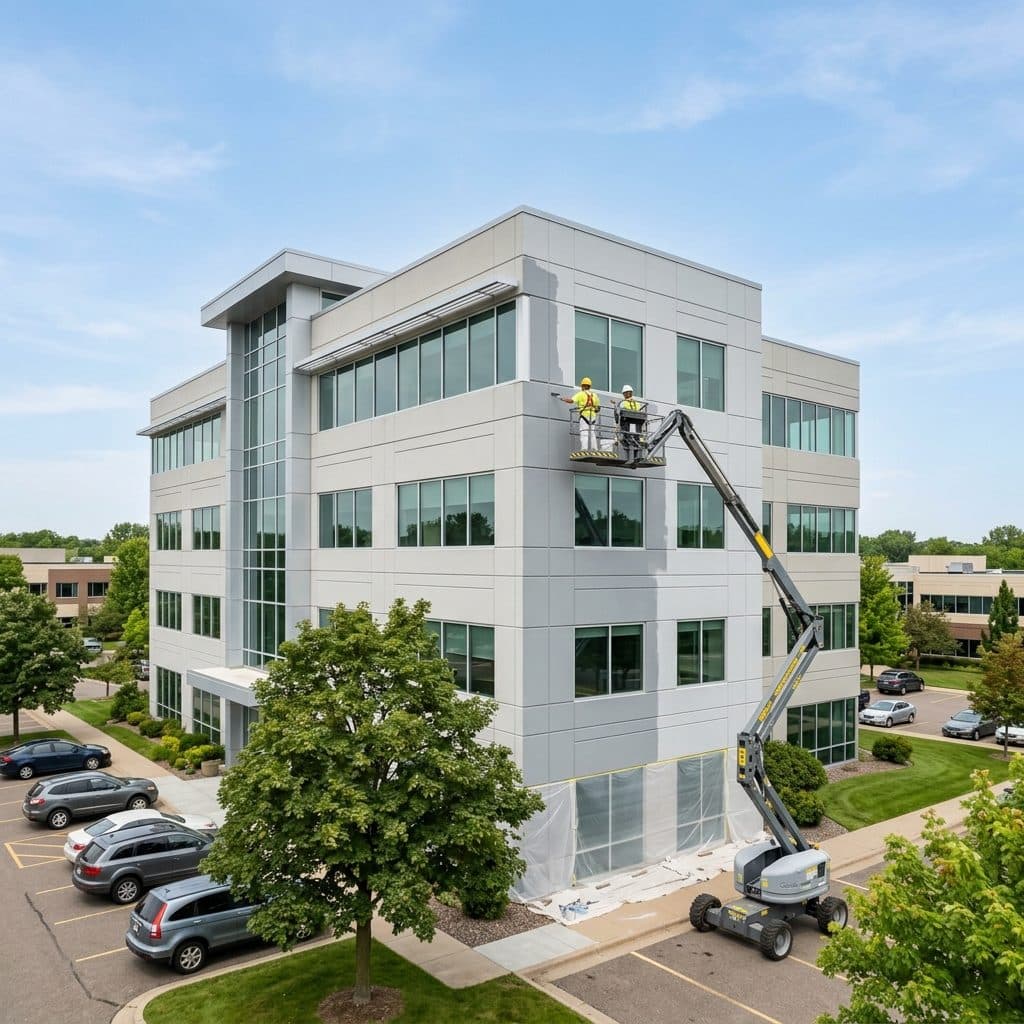
Access and height matter first. Ground-floor walls go fast. A second-story exterior or a stairwell with a two-story drop needs lifts, scaffolding, or swing stages, and that equipment adds cost before a single wall gets painted.
Occupied-building phasing is the factor a square-footage number cannot see at all. A vacant warehouse gets painted wall to wall in one pass. A working office, retail space, or medical building has to be painted in zones around business hours, which stretches both timeline and labor cost for the same square footage.
Substrate mix and coating specification round out the list. Commercial interior work routinely combines concrete block, metal door frames, and previously coated drywall, while exterior work adds structural steel, masonry, and UV exposure, and each surface needs different prep. A washable, scrub-resistant finish for a high-traffic corridor costs more than a builder-grade flat on identical wall area, and a dark-to-light color change often means an extra coat across the whole surface.
What a Cost-Per-Square-Foot Number Actually Includes
A published rate bundles several costs together. Knowing what is inside it makes any quote easier to read.
| Cost component | Typical range |
|---|---|
| Commercial paint labor | $50 – $100 per hour |
| Paint, acrylic | $25 – $60 per gallon |
| Paint, elastomeric | $40 – $80 per gallon |
| Paint, epoxy | $50 – $120 per gallon |
| Paint, specialty coating | $75 – $150 per gallon |
| Scaffolding or lift rental | $500 – $1,500+ per day |
Labor alone can range twofold depending on region and complexity, and the coating you specify moves the material cost by as much as sixfold, both of which sit inside every published per-square-foot figure whether the source says so or not.
Twin Cities Climate and Building Stock Cost Drivers
Two things specific to the Twin Cities metro affect commercial painting costs more than a national cost guide accounts for.
The first is the season. Exterior commercial work here runs roughly May through early October, the same window as residential exterior painting, while interior commercial work continues year-round. A building needing exterior work outside that window is working around a shorter bidding season, which affects scheduling and, at the margins, price.
The second is the metro's mixed commercial building stock. Minneapolis and St. Paul's older commercial corridors carry painted brick and masonry that need breathable coatings rather than a hard film that traps moisture. Newer suburban builds across Eden Prairie, Woodbury, and Maple Grove lean more toward concrete block, metal-frame construction, and structural steel, where rust treatment and primer selection matter as much as the finish coat. UV exposure adds to the wear, a factor covered in more depth in why commercial exteriors fade. Durahome's own exterior project data puts Minnesota at roughly 30 freeze-thaw cycles a year, and that cycling works against any coating that was not prepped correctly. Read more about how Minnesota weather damages exteriors.
Labor is also a real input here. The U.S. Bureau of Labor Statistics reported a median annual wage of $48,660 for construction and maintenance painters nationally as of May 2024, and the Minneapolis-St. Paul-Bloomington metro has historically run several percent above the national wage average across occupations. That regional labor cost is part of why a Twin Cities bid will not always match a number pulled from a national calculator.
Surface Prep, Repair, and Plastering Costs Before Painting
Prep is where a commercial estimate separates from a square-footage guess, and it is where commercial painting and plastering cost questions come in most often.
| Prep item | What it involves | Typical cost impact |
|---|---|---|
| Drywall patching | Filling holes, dents, and seams before priming | Minor per patch, adds labor hours across a large suite |
| Plaster or stucco crack repair | Rebuilding cracked or failed sections before coating | Can meaningfully raise the bid on older masonry facades |
| Priming bare or repaired areas | Sealing patched drywall, bare metal, or masonry | Usually bundled into the labor line, not billed separately |
| Rust treatment on metal frames | Treating corrosion on door frames, railings, or steel | Scales with how much corrosion is present, not with wall area |
None of this shows up in a bare cost-per-square-foot number, and all of it shows up in the final bid. Read more about spotting signs of stucco problems before a repaint.
What's In a Durahome Written Commercial Estimate
Every Durahome commercial estimate is built around the same trust stack, regardless of building size.
The No-Surprise Guarantee. A fixed written price for the agreed scope. Customer-added scope is priced and approved in writing before extra work begins.
A written, itemized estimate. Surfaces, prep, products, protection, timeline, and exclusions are spelled out before any commitment.
A written warranty, scaled to scope. Always spelled out in full, never quoted as a flat number.
One group text, no call center. The production manager, owner, estimator, and crew foreman are in one thread with you from day one.
The same crew, not a rotating roster. Around 90% of Durahome's painters stayed with the company last year, and most carry close to a decade of experience.
Documented progress. Crews photograph prep, so there is a record you can show an owner or a board.
Read verified project reviews or see the full commercial painting process in detail.
Getting a Commercial Painting Cost Estimate You Can Actually Budget Around
A square-footage range is a useful starting point for a budget conversation, not a number you can put in front of a board and expect it to hold. The next step that actually answers what your project will cost is a estimate, where an estimator reads the building the way it is really built and returns a fixed written price with a real start date attached to it.
Get a free commercial painting estimate to get a number built around your building, not a metro-wide average.
Frequently Asked Questions
How much does commercial painting cost per square foot?
Published rates commonly run $2 to $6 per square foot for interiors and vary more widely for exteriors, depending on the source. Durahome quotes an exact price per project after a estimate rather than applying a flat per-square-foot rate, because access, substrate, and phasing move the number as much as square footage does.
Why is the number I found online different from my estimate?
Published ranges are averages across every kind of building and market, and local rates vary as much as national ones do. Your bid reflects your building's access, substrate mix, phasing needs, and prep condition, which is why a estimate-based estimate is more accurate than any formula.
Is commercial painting more expensive than residential painting?
Usually, since commercial buildings are larger and involve more substrate types, access equipment, and coordination around occupied hours. The rate itself is not always higher, but the total project size typically is.
Does a commercial painting estimate include plaster or drywall repair?
Yes, when it is part of the agreed scope. Drywall patching, plaster or stucco repair, and rust treatment on metal surfaces are itemized in the written estimate rather than folded into a per-square-foot number.
How long does a commercial painting project take?
It depends on size and phasing. A single office suite might take a day or two, while a full building painted in zones around business hours can run several weeks. Exterior work is scheduled within the May through early October window.
Do you paint occupied buildings during business hours?
Yes. Work is phased by zone so tenants and staff keep access throughout, with the schedule agreed before day one and each space reset to working condition at the end of every shift.
How often should a commercial building be repainted?
It depends on traffic, exposure, and surface material. High-traffic interiors and sun-exposed exteriors need more frequent repainting than a low-traffic interior office or a shaded, well-maintained exterior.